

It is 8 PM. Your child is sitting at the laptop. The screen is on. They look focused. Maybe even a little stressed, in a productive way. You feel that quiet satisfaction of a parent whose child is “doing well.”
Then you walk past. Just for a second.
They click something. The tab changes. You both pretend you didn’t see what you just saw.
That quiet gap, every single evening, is what compounds over months into a Class 10 student who sat in front of a screen for 900 hours but cannot explain a single chapter.
This is not a parenting failure. This is a design problem. And until we see it clearly, we cannot fix it.
The Problem Nobody Is Talking About Out Loud
Every parent in India right now is dealing with the same invisible challenge: their child is on a device for hours, and on paper, it looks like studying. Online classes. YouTube tutorials. Educational apps. PDFs. Notes in a Google Doc.
It all looks right from the outside.
But the inside of that screen is a completely different story.
61% Urban Indian parents report their children spend three or more hours daily on social media and online games, a second school with no teachers, no curriculum, and a business model built entirely on keeping their children’s attention as long as possible. (Local Circles Survey)
A child can watch a lecture for five minutes, switch to gaming, spend 45 minutes watching reels, and return to the “study tab” the moment they hear footsteps. By the time you check in, the screen looks exactly the way it should.
Visibility without understanding is not safety. It is false confidence.
Why Traditional Monitoring Does Not Work Anymore
A generation ago, monitoring was simple. Books were physical. Homework had a beginning and an end. Teachers sent notes home. You could see progress, or the lack of it, with your own eyes.
Today, everything is behind a screen. And screens were not built for your convenience as a parent. They were built by engineers whose sole job is to capture and hold attention, especially a child’s attention, which is the easiest kind to capture and the hardest kind to reclaim.
You cannot parent your way through an algorithm. The standard advice, “set rules,” “have conversations,” “check in regularly”, is good advice that survives approximately nine days before the environment overwhelms it.
What parents are being asked to do, without realising it, is to out-engineer platforms that employ thousands of specialists to do exactly the opposite. That is not a fair fight. And it is not a fight you should have to win alone.
The Real Danger Is Not Distraction. It Is False Security.
When we talk about children and screens, most conversations go immediately to addiction or screen time limits. But the more serious problem for most Indian families is something quieter.
It is the parent who believes their child is studying regularly. Who is proud of the hours being logged? Who has built a mental picture of progress, a picture that does not match reality?
What parents believe: “My child is studying for 3 hours every evening.” “They are using technology productively.” “I would know if something was wrong.”
What often happens: Actual learning may be under 40 minutes. Attention is split across multiple tabs. Important signals go unnoticed.
The danger here is not just academic. According to the latest NCRB reports, cybercrimes against children are surging year after year. Harmful content, addictive games, and unsafe downloads are literally three clicks away from any homework search.
And because it all happens quietly, invisibly, behind a screen that always shows the right tab when you walk in, most parents find out too late.
What Modern Parenting Actually Requires
Here is something worth sitting with: the goal of digital parenting is not control. Over-control creates resistance. No control creates risk. What is needed is something in between, awareness with wisdom, structure without pressure.
A parent today needs three things:
1. Visibility
not surveillance, but a clear picture of what is actually happening on that device. Which sites are being visited? Where is the time going? What is getting blocked before it even loads?
2. Structure
a digital environment that makes studying easier than being distracted. Not rules that a child argues against, but a design that gently points them in the right direction before they even consciously choose to wander.
3. Confidence
the ability to say “I know my child is learning safely” instead of “I hope my child is learning safely.” These two sentences feel similar. They are worlds apart.
This Is Exactly Where Apni Prerna Comes In
Apni Prerna, built by Apni Pathshala, is a parenting support tool designed for precisely this moment in Indian education. It is not spyware. It is not a surveillance system. Think of it the way you think of a seatbelt, present and quiet, noticed only when something would have gone wrong without it.
It turns a child’s computer from a distraction machine back into a learning tool. Not by threatening, not by punishing, but by design.
Automatic content blocking Adult content, gambling sites, and malware are blocked before they even load. No pop-ups, no negotiations.
Study-hour structure Games and entertainment are limited during study time, the same way a classroom limits distractions.
Parent dashboard Real-time view of sites visited, time spent, and what was blocked. Weekly summaries in plain language.
Builds lasting habits A child who grows up with structured digital habits does not need to be monitored forever. The goal is calibration, not control.
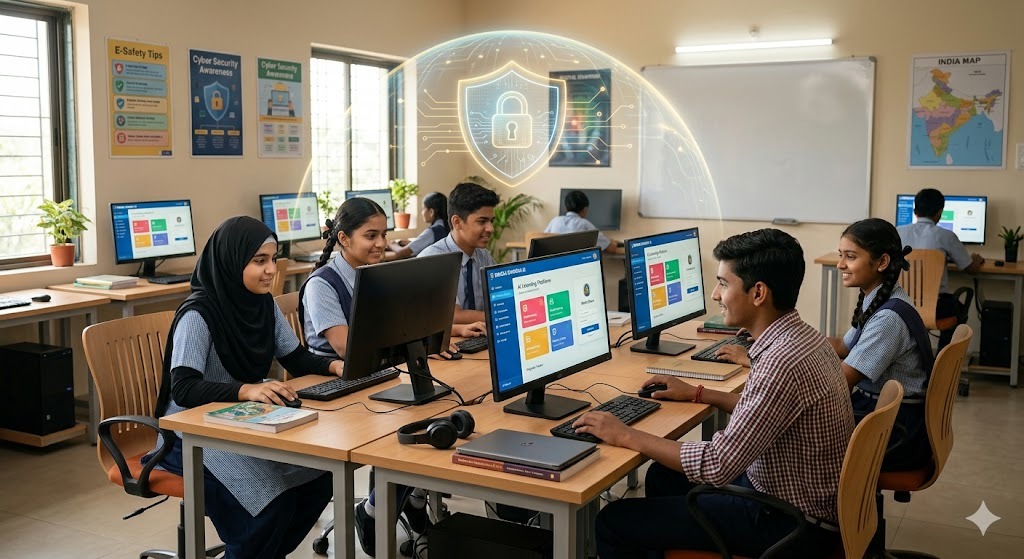
It is already deployed across more than 30 community learning centres across India, where a single POD leader manages an entire computer lab alone. Without a system like this, every such centre slowly becomes a cyber cafe. With it, the centre stays a classroom.
Let Us Be Clear About What It Is Not
Because this part matters more than any feature list.
Apni Prerna does not watch your child through a webcam. It does not read private messages or personal communications. It does not report data to external authorities. It does not work on mobile phones; it is for computers only. It does not punish, alert, or shame the student in any way.
Think of a physical library. Nobody forces you to be quiet inside. No armed guard stands at the door telling you to read. The environment itself produces the behaviour, because it was built that way. Apni Prerna does the same thing, digitally.
That is a fundamentally different approach from the generic parental controls buried in Windows that your child bypassed in eleven minutes flat.
A Question Before You Read On
Open your child’s browser history right now. Not to punish them. Just to look.
If what you see matches what you assumed they were doing, that is genuinely great. Close this page and carry on.
But if there is a gap, if the reality is even slightly different from the assumption, then that gap is worth taking seriously. Because of that quiet gap, every evening, is what compounds over months into a board exam result that confuses everyone who was watching but not really seeing.
Indian parenting has always been deeply involved. That is a strength, not a flaw. But digital parenting requires an updated version of that same instinct.
Instead of asking “How many hours did you study today?”, we need to start asking “What did you actually learn?” Instead of measuring time, we need to understand quality. Instead of assuming safety, we need tools that confirm it.
The government’s latest economic survey explicitly flagged rising digital addiction among Indian youth and called for structural intervention, not more awareness campaigns. The researchers have documented it. Parents feel it every evening. Policy takes years. Your child’s exam is in a few months.
The internet was not built for your child. But with the right system running quietly in the background, their computer absolutely can be.
Conclusion
Tools like Apni Prerna are not about distrust. They are about giving parents the same thing a good teacher has always had: a clear picture of what is happening, so they can respond with wisdom instead of anxiety.
Your child’s future is not just about studying more. It is about learning safely, learning meaningfully, and building habits that last far beyond the next exam.
The illusion of study time is real. Millions of Indian parents are living inside it right now, not because they are careless, but because the gap between what screens show and what screens do is invisible by design.
Awareness changes everything. When you know what your child is actually doing, how their time is actually being spent, and whether they are actually safe, you stop guessing and start guiding. You stop reacting and start building.
Take the first step towards safer digital learning for your child, visit here